


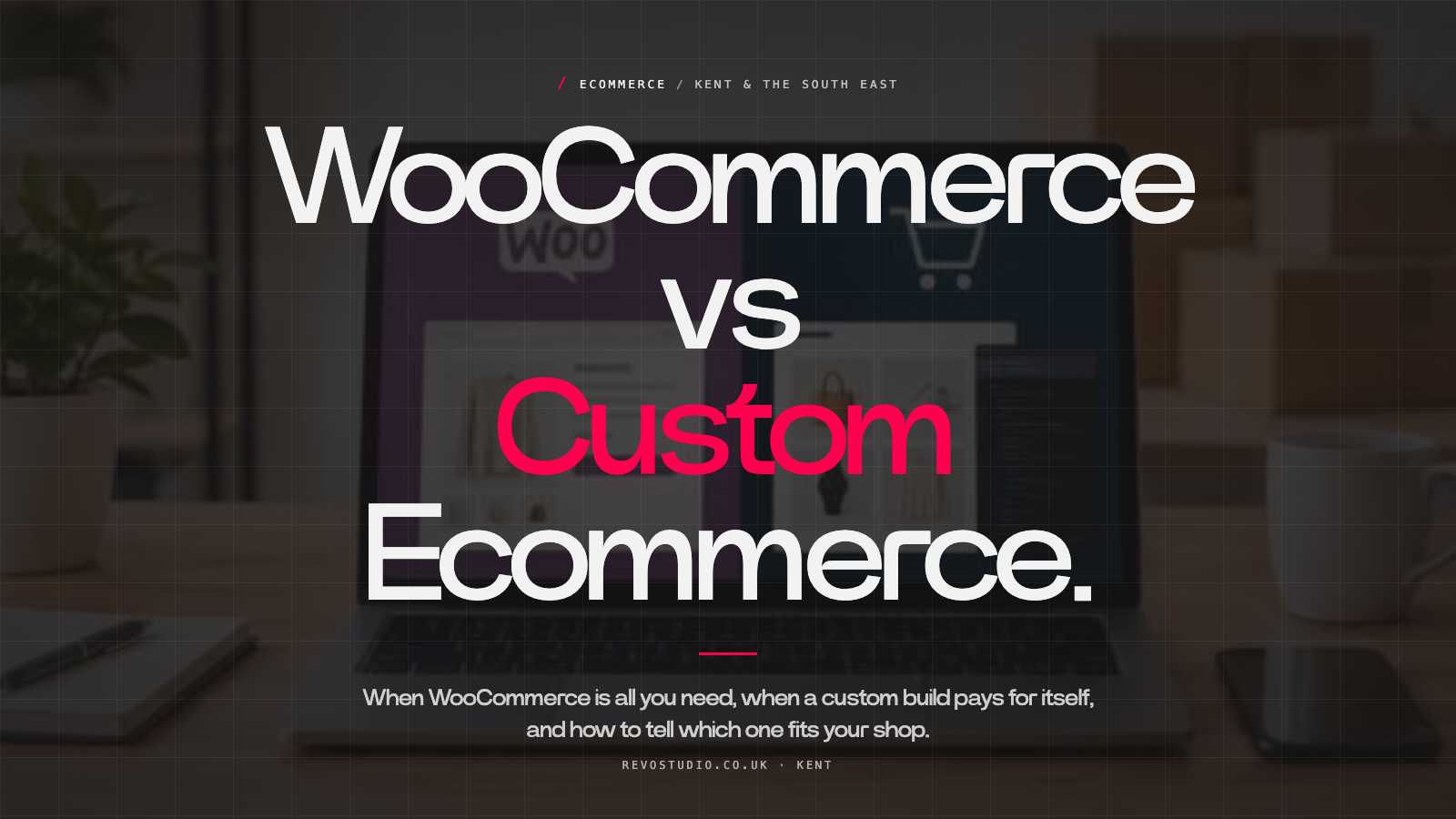
A shop that looks smart but makes ordering awkward is not doing its job. Neither is a cheap build that works for six months, then becomes a pile of plugins, workarounds and excuses. The WooCommerce vs custom ecommerce decision is really about one question: what does your business need the website to do now, and what will it need to do when sales pick up?
For many small and medium-sized UK businesses, WooCommerce is the sensible answer. It is flexible, familiar and capable of supporting a properly designed online shop without paying to reinvent basic ecommerce functions. For others, a fully custom ecommerce platform earns its higher price by solving operational problems that an off-the-shelf system cannot.
The trick is not to be seduced by either extreme. You do not need a bespoke system because someone says your business is special. Equally, you should not force an unusual sales process into WooCommerce simply because the initial quote is lower.
What WooCommerce gives you
WooCommerce is an ecommerce platform built for WordPress. It adds products, basket and checkout functionality to a WordPress website, while giving you a large choice of payment methods, delivery options, product variations and stock controls.
Its biggest strength is that it does not have to look like a template shop. With the right design and development work, a WooCommerce website can be completely tailored to your brand, product range and customer journey. Your homepage, category pages, product pages and checkout can all be designed around what helps people buy, rather than what a pre-made theme happens to allow.
It also puts day-to-day control in your hands. Adding products, updating copy, changing prices, running promotions and managing orders should not require a developer every time. That matters when you are running a business, not a digital project.
For a straightforward product catalogue, WooCommerce is often more than enough. Think clothing, food and drink, gifts, trade supplies, homeware, tickets, subscriptions or made-to-order products with sensible options. It can also work well for businesses selling a mix of physical products, services and digital downloads.
The cost advantage is real, but it needs context. WooCommerce itself is not the expensive part. The investment goes into strategy, design, development, product setup, integrations, hosting, maintenance and making sure the whole thing works properly on mobile. A cheap WooCommerce build can still be expensive if it loses sales or needs rebuilding a year later.
Where WooCommerce can start to strain
WooCommerce is adaptable, but it is not magic. Every added function needs to be considered carefully. A shop loaded with poorly chosen plugins can become slow, difficult to update and frustrating to manage.
Problems usually appear when a business has complex rules behind the sale. Perhaps prices vary by customer account, stock is held across several warehouses, products need unusual configurators, trade customers require approval before ordering, or the website must exchange live data with a bespoke internal system.
None of these automatically rule WooCommerce out. Some can be handled cleanly with an existing extension or a small piece of tailored development. The issue is whether the solution remains reliable and manageable. If every new requirement involves another plugin sitting on top of three earlier plugins, it is time to step back.
A sensible WooCommerce build should be selective. Use proven tools for standard jobs and custom development only where it creates a clear commercial advantage. No smoke, no shortcuts, and no plugin graveyard hiding under the bonnet.
WooCommerce vs custom ecommerce: the real difference
Custom ecommerce can mean different things, which is why quotes can be confusing. Sometimes it means a bespoke website design built on WooCommerce. That is often a very good middle ground. Other times, it means a completely custom platform built from scratch, with its own product management, ordering logic, customer accounts and integrations.
These are not comparable options in the same way. A bespoke WooCommerce website uses a proven ecommerce engine but gives you a tailored customer-facing experience. A fully custom platform builds both the experience and much of the engine itself.
| Area | WooCommerce | Fully custom ecommerce | | — | — | — | | Launch speed | Faster when requirements are conventional | Longer because core functions are built and tested | | Upfront cost | Usually lower | Usually much higher | | Flexibility | Excellent within the WordPress ecosystem | Built around your exact rules and processes | | Administration | Familiar and accessible for most teams | Can be made to fit your workflow precisely | | Ongoing reliance | Needs updates and sensible maintenance | Needs a capable development partner for changes | | Best fit | Most growing product businesses | Complex operations with a strong business case |
A custom platform gives you control over the details, but that control comes with responsibility. You are paying for the initial build, future improvements, security, testing and support of systems that a platform like WooCommerce already provides. That can be worthwhile. It is not automatically better.
When a custom ecommerce platform makes sense
A fully custom build starts to make commercial sense when the website is tightly connected to how the business operates. The site may need to calculate complicated quotes, manage a marketplace, process large volumes of bespoke orders, handle unusual fulfilment rules or integrate deeply with ERP, warehouse and manufacturing systems.
It can also be the right route when performance at scale is critical. If you have thousands of products, high order volumes, multiple territories or very specific account structures, a purpose-built system may remove inefficiencies that cost your team time every day.
The key phrase is commercial sense. A custom platform should solve a problem with a measurable cost. Saving an operations team ten hours a week, reducing order errors, shortening a sales cycle or enabling a new revenue model can justify the investment. Wanting a site that feels more premium does not require a custom platform. Good brand and web design can do that perfectly well on WooCommerce.
Do not confuse bespoke design with bespoke software
This is where businesses are often sold the wrong thing. You may need a custom-designed ecommerce website, with distinctive branding, carefully considered product pages and a checkout journey built around your customers. That does not mean you need custom software.
For example, a Kent-based food producer selling gift boxes, subscriptions and corporate orders could benefit from a beautifully tailored WooCommerce shop. Their challenges are likely to be product presentation, delivery cut-offs, stock visibility and making repeat purchases easy. All are achievable without building an ecommerce engine from scratch.
A trade supplier is different. If each customer has negotiated prices, product availability depends on account status, and orders need to feed directly into a legacy stock system, the technical case for deeper custom work is stronger. Even then, WooCommerce may still form part of the solution. The answer is rarely all-or-nothing.
Start with the customer journey, then look behind the scenes
Before choosing a platform, map out how an order actually happens. How does a customer find a product? What information do they need before buying? Are they purchasing once, regularly or after speaking to a sales team? What happens after payment? Who packs the order, updates stock and handles returns?
Then look at the awkward bits. These are the parts worth discussing openly with your developer: pricing rules, delivery restrictions, product options, data imports, customer accounts, payment methods and integrations. If an agency avoids these questions and jumps straight to a platform recommendation, you are being given a sales answer rather than a technical one.
It is also worth separating requirements from preferences. A wishlist may be nice to have. Live trade pricing may be essential. A slick product filter may improve conversion. A custom product builder may be the entire reason a customer chooses you. Prioritising properly protects the budget and keeps the first launch focused.
Think beyond launch day
The platform decision affects far more than the build. It shapes how quickly your team can add products, how easily marketing can create landing pages, how search content is managed and how confidently you can improve the shop over time.
WooCommerce is particularly useful where organic visibility matters because it sits within WordPress. Product pages, category copy, guides and supporting content can all live in one managed website. That gives you a practical foundation for building search traffic rather than relying solely on paid campaigns.
Whichever route you choose, budget for ongoing care. Software updates, security checks, backups, payment changes and conversion improvements are part of running an online shop. They are not optional extras that appear after the launch photo has been taken.
The right answer is the one that lets customers buy with confidence and lets your team run the shop without unnecessary drama. Choose WooCommerce when it gives you what you need with room to grow. Choose custom ecommerce when the complexity of your business genuinely demands it. Spend the difference on the parts customers notice: clear branding, useful product information, fast pages and a checkout that does not get in their way.

Keep Reading
Related Articles
 Web Design
 Kent That Works Harder for Business
Web design Kent businesses can rely on: custom websites that build credibility, guide enquiries and sales, and give you control after launch without fuss.
Read Article Web Design
WordPress Versus Squarespace Websites Compared
WordPress versus Squarespace websites: compare control, cost, SEO and growth potential to choose the right platform for your UK business as you grow.
Read Article Web Design
How to Design a Service Website That Wins Work
Learn how to design a service website that builds trust, answers buyers' questions and turns local searches into qualified enquiries without fluff.
Read Article